• Link to Mail
  • Link to Facebook
  • Link to Instagram
  • Link to LinkedIn
  • Link to X
  • Link to Tumblr
  • For Clinicians
    • Employment Opportunities
    • Private Practice Consultation
    • CE Trainings
410 S. Michigan Ave. Suite 928 ~ Chicago 60605 | SCHEDULE ONLINE
DK Therapy
  • Services
    • Individual Counseling
    • Couples Counseling
    • EMDR Counseling
    • Online Counseling
      • Getting Started with Online Video Sessions Guide
    • For Clinicians:
      • DK Therapy CE Trainings
      • Employment Opportunities
      • Consultation
  • Meet The Team
    • Meet The Team
    • Amber DiCosola, LCPC
    • Catherine Watson, LCPC
    • Chris Dubois, LPC
    • Clara Gay, LSW
    • Claudia Hernandez, LCPC
    • Dana Norden, LCSW
    • Danielle Kepler, LCPC
    • Jasmine Goins, LCSW
    • Josh Bate, LPC
    • Joslyn Mowen, LCPC
    • Kelsey Kamin, LSW
    • Rachel Kurt, LCPC
    • Sydney Walden, LCSW
  • Your First Visit
    • Insurance/Fees
    • Good Faith Estimate
    • Your First Visit
    • Q&A
  • Blog
    • In The Media
  • Contact
    • Schedule Online
    • Insurance Verification
  • Menu Menu
Blog

You are NOT Your Mental Illness

August 6, 2015/in Life Outside the Office

I was walking home yesterday and I heard a man on his phone say “My back is bothering me again, so I thought I’d call and get it checked out.” I can assume he was talking to his doctor or chiropractor. This got me thinking about how his conversation would have been different had he been calling a therapist (or any mental health professional). Would he feel comfortable having the same conversation talking about his anxiety, (“My anxiety is acting up again, so I thought I’d call and get it checked out”) in a public place with a handful of people able to hear his conversation? Maybe, but most likely not.

The initial phone calls I receive from clients are ones with hushed voices or sometimes tears. Most people don’t even call, they opt for e-mailing instead. This got me thinking or should I say hoping that one day people will be able to freely have that conversation with a therapist just like they would a back doctor without the shame or stigma attached.

One of the most memorable moments in my training as a therapist was when I was an intern during the summer between my junior and senior years of college. I was working in a partial hospitalization program at a local hospital. While I was observing a group psychotherapy session, all of a sudden the therapist slammed his hand down on the table and said (in a very loud voice) “NO! You are NOT bipolar. Bipolar disorder is something you have, NOT something you are and since you have it you can manage it. The fact that you have bipolar disorder does not and should not define who you are as a person.” That moment really stuck with me and still does to this day.

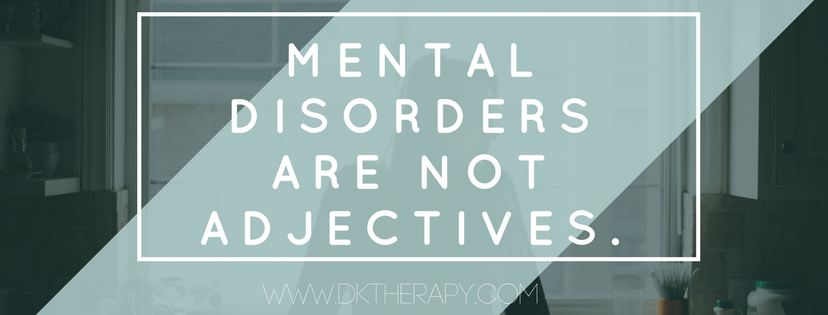
So often, we use mental illness as an adjective or a word that describes a noun (usually ourselves or another person) when in fact if you look up “anxiety” in the dictionary it states “noun 1. a feeling of worry, nervousness, or unease, typically about an imminent event or something with an uncertain outcome.” or “depression” as “noun 1. the state of feeling sad.” Sure, depressed is technically an adjective. But I hope you see my point here. When did society start defining themselves by their current mental state and making it more of a permanent attribute when it really is not? People already define themselves by their current careers, much to their detriment. I can only imagine the harm defining yourself by your current mental state. It leaves very little room for flexibility (career-wise or mental-state wise!) to even think of yourself in any other way.

I like to do my part in separating clients from their mental illness (making it a noun and not an adjective) and I correct them when they say “I am depressed” by saying “You have depression” or “You are experiencing anxiety” rather than “I am anxious.” I also give this little word game as homework to clients so that they can start the shift and start seeing their current mental state as temporary and not something that has to define them. Hopefully people will soon reference mental illness like they do physical illness “I have a backache” “I have a cold” “I have anxiety.” I have never heard anyone say “I am a backache.”

Hopefully this post leaves you with the take-home that one’s current mental state does not have to define him or her. It’s as simple as switching a few words around in your lexicon to begin making that change.

 

Tags: mental illness, stigma
Share this entry
  • Share on Facebook
  • Share on X
  • Share on WhatsApp
  • Share on LinkedIn
  • Share on Tumblr
  • Share by Mail
https://chicagocounselingandtherapy.com/wp-content/uploads/2017/08/16.png 315 828 Danielle Kepler, LCPC https://chicagocounselingandtherapy.com/wp-content/uploads/2018/01/DKTherapyLogoSm.png Danielle Kepler, LCPC2015-08-06 16:05:332018-02-02 14:57:08You are NOT Your Mental Illness
You might also like
LGBTQIA Community and Mental Health Stigma
Two women, one middle aged and one older, sitting next to each other and laughing on a park bench. Breaking the Stigma: Talking About Mental Health with Friends and Family
A woman staring through a transparent hexagon at her reflection in the mirror. Schizophrenia: Breaking Down Myths and Understanding the Reality

SCHEDULE ONLINE NOW

Recent Posts

  • A middle aged or older man with dark brown hair and a light brown jacket drinking out of a white espresso cup outdoors in a city.
    How to Create a Fulfilling Life After Your Children Leave HomeMay 22, 2026 - 10:47 am
  • A woman with brown skin and black hair sitting at a counter with a cup of coffee and a muffin in front of her, with her head in her hand and her eyes closed, looking frustrated.
    How to Handle Caring for a Loved One When Your Efforts Go UnnoticedMay 20, 2026 - 2:40 pm
  • A black and white photo of an Asian woman looking sad and holding her hands up to her mouth like she's thinking.
    Missing Milestones and Mourning the Life You ExpectedMay 7, 2026 - 4:26 pm

verified by Psychology Today

Now offering secure, convenient online counseling/therapy sessions! Learn more

Latest Blog Posts

  • A middle aged or older man with dark brown hair and a light brown jacket drinking out of a white espresso cup outdoors in a city.
    How to Create a Fulfilling Life After Your Children Leave HomeMay 22, 2026 - 10:47 am
  • A woman with brown skin and black hair sitting at a counter with a cup of coffee and a muffin in front of her, with her head in her hand and her eyes closed, looking frustrated.
    How to Handle Caring for a Loved One When Your Efforts Go UnnoticedMay 20, 2026 - 2:40 pm
  • A black and white photo of an Asian woman looking sad and holding her hands up to her mouth like she's thinking.
    Missing Milestones and Mourning the Life You ExpectedMay 7, 2026 - 4:26 pm
  • A Black teenage boy, shrugging his shoulders with his hands in the air like he's confused.
    Alexithymia Symptoms and Why Emotions Can Feel Out of ReachApril 24, 2026 - 5:14 pm
  • A light skinned woman with dark blonde curly hair standing in front of a brick wall, holding her arms up like she's frustrated.
    How to Cope When You’re Overlooked for a Promotion at WorkApril 22, 2026 - 3:54 pm

410 S. Michigan Ave. Suite 928

Cancellation Policy

Please note that we require a 24-hour notice if you decide to cancel your appointment. Call or email to cancel or reschedule at least 24 hours before your scheduled appointment in order to avoid charges. We will do our best to accommodate you and appreciate your cooperation. Thank you.

© Copyright 2026- DK Therapy, LLC
  • Services
  • Meet The Team
  • Your First Visit
  • Blog
  • Contact
Link to: 5 Common Obstacles That Stop You From Practicing Mindfulness and How to Overcome Them Link to: 5 Common Obstacles That Stop You From Practicing Mindfulness and How to Overcome Them 5 Common Obstacles That Stop You From Practicing Mindfulness and How to Overcome...Link to: The Importance of Emotional Connection During Everyday Activities Link to: The Importance of Emotional Connection During Everyday Activities The Importance of Emotional Connection During Everyday Activities
Scroll to top Scroll to top Scroll to top