
• Link to Mail
  • Link to Facebook
  • Link to Instagram
  • Link to LinkedIn
  • Link to X
  • Link to Tumblr
  • For Clinicians
    • Employment Opportunities
    • Private Practice Consultation
    • CE Trainings
410 S. Michigan Ave. Suite 928 ~ Chicago 60605 | SCHEDULE ONLINE
DK Therapy
  • Services
    • Individual Counseling
    • Couples Counseling
    • EMDR Counseling
    • Online Counseling
      • Getting Started with Online Video Sessions Guide
    • For Clinicians:
      • DK Therapy CE Trainings
      • Employment Opportunities
      • Consultation
  • Meet The Team
    • Meet The Team
    • Amber DiCosola, LCPC
    • Catherine Watson, LCPC
    • Chris Dubois, LPC
    • Clara Gay, LSW
    • Claudia Hernandez, LCPC
    • Dana Norden, LCSW
    • Danielle Kepler, LCPC
    • Jasmine Goins, LCSW
    • Josh Bate, LPC
    • Joslyn Mowen, LCPC
    • Kelsey Kamin, LSW
    • Rachel Kurt, LCPC
    • Sydney Walden, LCSW
  • Your First Visit
    • Insurance/Fees
    • Good Faith Estimate
    • Your First Visit
    • Q&A
  • Blog
    • In The Media
  • Contact
    • Schedule Online
    • Insurance Verification
  • Menu Menu

Why It’s Harder to Forgive Yourself Than Others—And How to Start

Why It's Harder to Forgive Yourself Than Others: And How to Start


People often value forgiveness as a path toward healing and inner peace. Yet, when it comes to forgiving ourselves for our mistakes, many of us struggle. We forgive others for the same trespasses we punish ourselves for, because it’s a challenge to let go of guilt and regret. However, to live a happy, healthy life, we need to be able to treat ourselves with the same compassion we direct to our loved ones.

Change is easier said than done, though, so how can you begin to cultivate self-compassion and start to forgive yourself? Keep reading for tips.

Why Is It So Hard to Forgive Yourself?

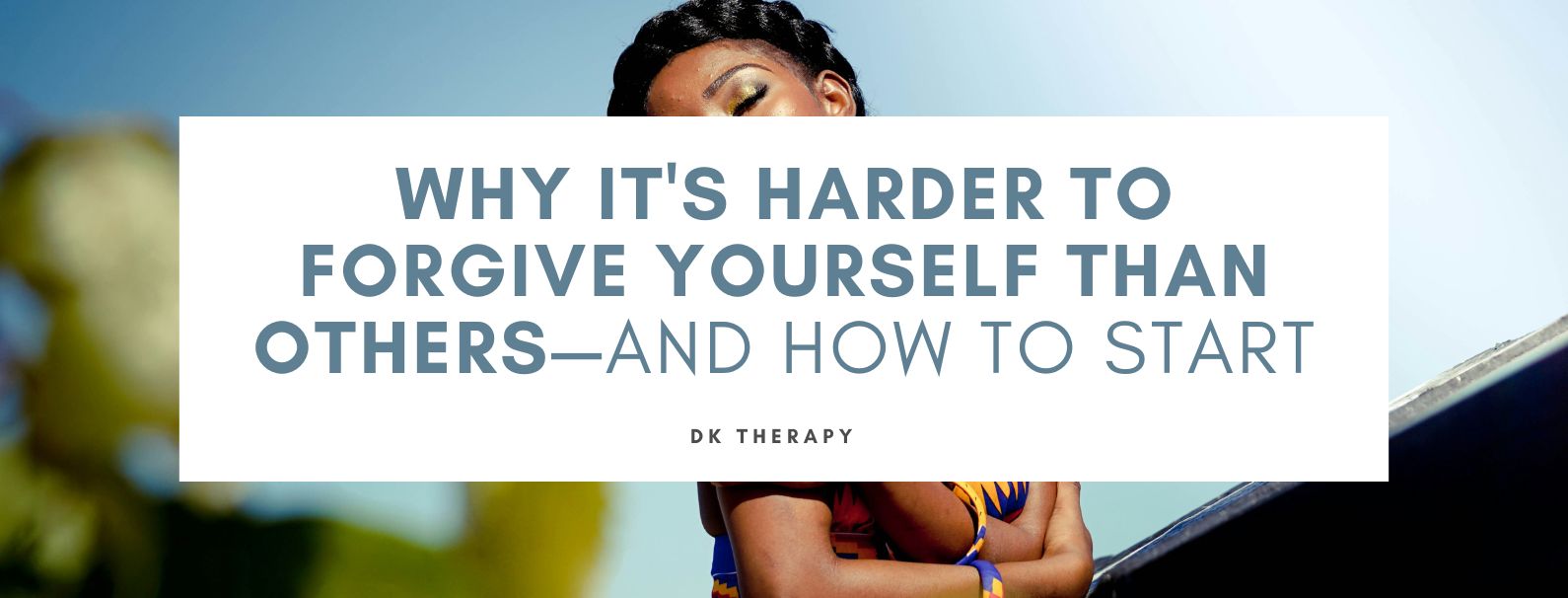
A Black woman in a brightly colored dress hugging herself against a blue sky, with some plants in the foreground.When someone else hurts us, we can recognize their faults and decide whether to move forward. However, when we make our own mistakes, we often hold onto them as proof of our perceived inadequacy. Personal accountability, while important, can lead to self-judgment rather than growth.

In addition, many people struggle with forgiving themselves because they hold themselves to impossible standards. If you believe you should never fail or make mistakes, any misstep feels catastrophic. Unlike others, whom we may grant grace and understanding, we often don’t extend the same kindness to ourselves.

Finally, some people resist self-forgiveness because they believe it will make them complacent going forward. They fear that if they stop beating themselves up about something they’ve done wrong, they might repeat the same mistake. This introduces a negative cycle where self-punishment is mistaken for personal growth.

How to Forgive Yourself

The first step to forgive yourself is recognizing what you’re feeling and why. Instead of suppressing your guilt or shame, allow yourself to sit with these emotions. Understanding them helps you process them more effectively. Why are you upset? What harm have you actually done? With a clearer view of the situation, you have a better opportunity to think critically.

Next, try to remove yourself from the situation for a moment. Think about how you would respond if your friend or someone you love deeply made the same mistake. Would you scream at them or berate them? Would you remove them from your life, or would you understand that they’re human beings, and thus, prone to making mistakes?

Most likely, you’d encourage them to learn and move forward, so why not grant yourself the same mercy? You don’t have to punish yourself in order to learn and grow.

Take Responsibility Without Self-Punishment

Owning your mistakes can be very freeing; it doesn’t mean you need to dwell on them forever. Accepting responsibility should be about growth, not endless self-criticism. Apologize if necessary, make amends where you can, and move on with your life. No good will come from constantly wearing yourself down over something that has already happened.

Forgiveness comes from a place of kindness, remember. A kind and mature person typically forgives others when they’ve learned from a mistake they made. Treat yourself with the same acceptance and kindness you would with anyone else. After all, it’s important to set expectations when it comes to the compassion you expect, from yourself and others.

Forgiving yourself isn’t about excusing harmful behavior, though. Acknowledge mistakes you’ve made, take time to understand their impact, and do the best you can to become a better person for it. Growth and maturity don’t happen overnight, and the sooner you allow yourself the grace to move forward, the sooner you can find peace within yourself and the world around you.

If you’re struggling to forgive yourself and you’d like to work with a therapist, we encourage you to reach out to DK Therapy and schedule an appointment with our office.
SCHEDULE ONLINE NOW

Recent Posts

  • A middle aged or older man with dark brown hair and a light brown jacket drinking out of a white espresso cup outdoors in a city.
    How to Create a Fulfilling Life After Your Children Leave HomeMay 22, 2026 - 10:47 am
  • A woman with brown skin and black hair sitting at a counter with a cup of coffee and a muffin in front of her, with her head in her hand and her eyes closed, looking frustrated.
    How to Handle Caring for a Loved One When Your Efforts Go UnnoticedMay 20, 2026 - 2:40 pm
  • A black and white photo of an Asian woman looking sad and holding her hands up to her mouth like she's thinking.
    Missing Milestones and Mourning the Life You ExpectedMay 7, 2026 - 4:26 pm

verified by Psychology Today

Now offering secure, convenient online counseling/therapy sessions! Learn more

Latest Blog Posts

  • A middle aged or older man with dark brown hair and a light brown jacket drinking out of a white espresso cup outdoors in a city.
    How to Create a Fulfilling Life After Your Children Leave HomeMay 22, 2026 - 10:47 am
  • A woman with brown skin and black hair sitting at a counter with a cup of coffee and a muffin in front of her, with her head in her hand and her eyes closed, looking frustrated.
    How to Handle Caring for a Loved One When Your Efforts Go UnnoticedMay 20, 2026 - 2:40 pm
  • A black and white photo of an Asian woman looking sad and holding her hands up to her mouth like she's thinking.
    Missing Milestones and Mourning the Life You ExpectedMay 7, 2026 - 4:26 pm
  • A Black teenage boy, shrugging his shoulders with his hands in the air like he's confused.
    Alexithymia Symptoms and Why Emotions Can Feel Out of ReachApril 24, 2026 - 5:14 pm
  • A light skinned woman with dark blonde curly hair standing in front of a brick wall, holding her arms up like she's frustrated.
    How to Cope When You’re Overlooked for a Promotion at WorkApril 22, 2026 - 3:54 pm

410 S. Michigan Ave. Suite 928

Cancellation Policy

Please note that we require a 24-hour notice if you decide to cancel your appointment. Call or email to cancel or reschedule at least 24 hours before your scheduled appointment in order to avoid charges. We will do our best to accommodate you and appreciate your cooperation. Thank you.

© Copyright 2026- DK Therapy, LLC
  • Services
  • Meet The Team
  • Your First Visit
  • Blog
  • Contact
Link to: Music and Mental Health: How Teens Can Use Music to Manage Emotions Link to: Music and Mental Health: How Teens Can Use Music to Manage Emotions Music and Mental Health: How Teens Can Use Music to Manage EmotionsA teenage girl looking at the camera and holding a pair of headphones in her hands.Link to: The Role of Therapy in Eating Disorder Recovery Link to: The Role of Therapy in Eating Disorder Recovery Scrabble tiles arranged to spell out the words 'eating disorder' horizontally and 'anoriexia' and 'bulimia' vertically on a dark wood surface.The Role of Therapy in Eating Disorder Recovery
Scroll to top Scroll to top Scroll to top